Spectral Inheritance: Finding Science, Self and Family Across Generations
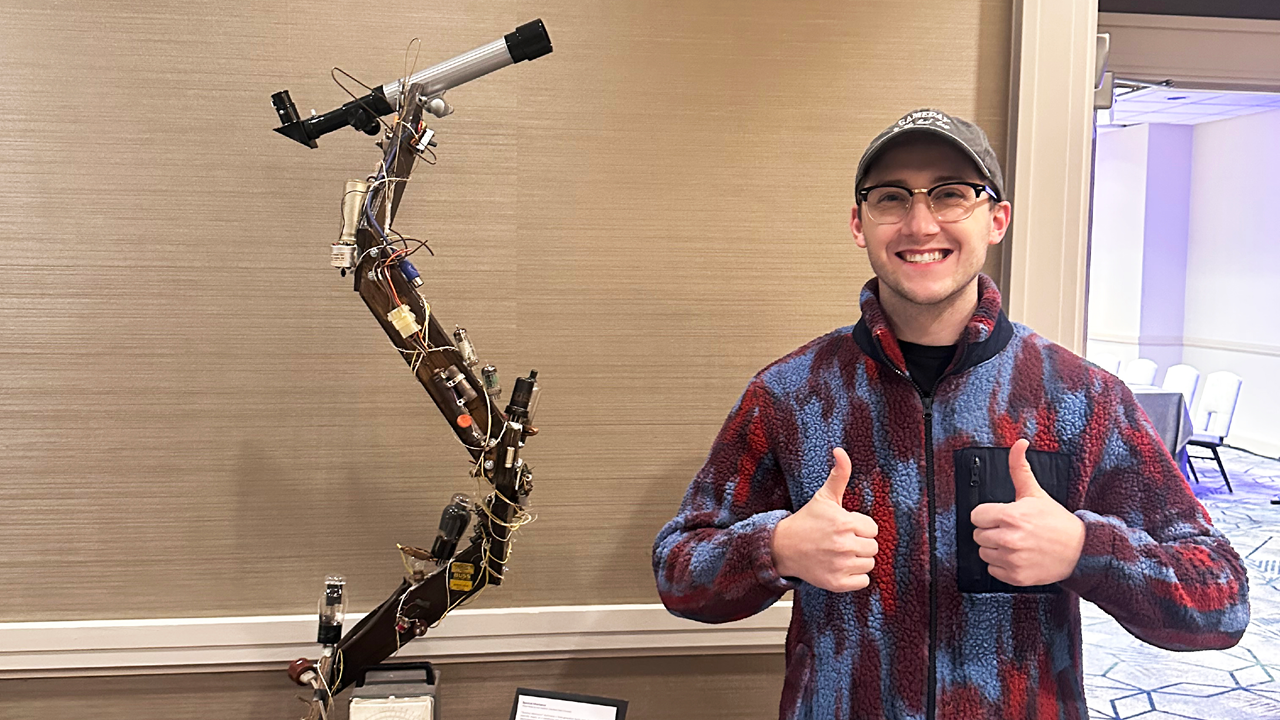
Cleveland State University physics major Josh Hoeflich won the top physics art prize at the 2025 Physics and Astronomy Congress in Denver, Colo., for Spectral Inheritance, an interdisciplinary project that blends scientific theory, creative expression and multigenerational storytelling.
The first-place award in the “Supporting (Our) Phase Shifts” category recognized Hoeflich’s work for expanding how physics is communicated beyond traditional academic boundaries. Hoeflich shared that the recognition came as an unexpected honor, expressing gratitude for the opportunity to have his work acknowledged.
“While I knew my goal with the piece fit the conference theme, I didn’t expect it to be viewed as the best representation of it,” he said. “This was likely because it was my first time attending, and I hadn’t fully grasped the scale or atmosphere of the conference beforehand. It was a validating shock.”
Hoeflich is expected to graduate in 2027 with his third degree, and plans to complete a four-plus-one master’s program the following year. He began his academic career studying physics at The Ohio State University, where he struggled to keep pace with his peers. That uncertainty led him to major in business and later to a position at NASA, an achievement many would consider a destination but one he viewed as a checkpoint.
“I realized while I was working at NASA that I could really be doing something I rather enjoy,” he said. “I wasn’t being kind enough to myself to recognize that I could do the things I wanted to do.”
A learning disability diagnosis in his mid-20s reframed his experience. What once felt like failure was a mismatch between how he was taught and learns. Returning to the world of physics changed how Hoeflich learned and valued his perspective, an insight central to his award-winning work. He also mentioned that though he aware of the disability, persevering is still challenging.
“Discovering the diagnosis was a tremendous step forward, but that alone didn't teach me the specific adjustments I needed,” said Hoeflich. “I often felt lost for words when asked what support I needed because I didn't realize exactly how it had impacted my prior education. However, seeing how the right accommodations have improved my academic performance is encouraging. I am sure I will keep learning more about how I work best for many years to come.”
The Project That Took Home the Prize
Spectral Inheritance stood out for combining scientific rigor with lived experience. The piece weaves vacuum tubes, wires, resistors and vintage tools—objects spanning nearly a century—into a three-generation story of electrical knowledge passed down and reinterpreted. Each material represents a different era, tracing the working life of Hoeflich’s grandfather, an electrician, and echoing how Hoeflich’s father once sourced electronic parts through informal networks such as Craigslist.
“It's funny to talk to my grandpa now with the physics background I'm getting and realize that we both understand intuition differently about physics and how electricity works,” Hoeflich added. “His understanding is through practice and his life's work, and my understanding is from a theoretical perspective.”
That conceptual clarity—bridging hands-on labor with abstract theory—elevated the piece from artful to award-worthy. At the center of Spectral Inheritance is a telescope aimed skyward, anchoring the installation and signalling its ambition.
For Hoeflich, it represents his long-standing interest in astronomy and a shift toward finding inspiration within himself.
“I feel encouraged by seeing that I’m capable of propelling myself into the headwinds, so to speak, in search of what I truly want,” he said. “I had a stable career and a path forward previously, but I didn’t identify with it. The deeper meaning I was craving was to spend my life learning about how it all works, especially through scientific exploration of our origins and possible cohabitants in this universe. Spectral Inheritance, to me, reflects that pursuit.”
Winning the Congress’s top physics art prize affirmed that shift, validating that his efforts truly mattered. The telescope also points to what remains unknown. Black holes, spacetime, mass, light—physics is still unfinished, still unfolding.
“That interests me,” he said. “The idea that we can still know more and we can still connect pieces. It's still a changing science.”
That perspective was reflected at the Congress, where Hoeflich met Dame Jocelyn Bell Burnell, the astronomer who discovered pulsars as a graduate student. As the Congress’s honorary chair, she spoke candidly about self-doubt, learning differences and carving out space for yourself in scientific fields.
“Don’t let your self-doubt count you out,” Hoeflich said.
The physical construction of Spectral Inheritance carries meaning as well. What began as a simple structure—wood cut into a spiral referencing the electromagnetic spectrum—evolved into layers of added significance. The woodworking unintentionally echoed his father’s work, who once made him wooden toys finished in dark, natural stains.
Because the piece had to travel by plane to the Congress, it was assembled and disassembled multiple times. Fragile vacuum tubes made it impossible to bring home intact. What remains are fragments, but the recognition of the award endures.
“I feel I’ve surpassed my own expectations of myself,” he said. “My old career often felt defined by my performance relative to others. Now, it truly feels as though I don’t have to compete to find joy, which is especially meaningful given that I wasn't finding joy in the competition I was in before. Knowing that I can up and change my environment when it's necessary, simply trusting myself to find stability, is incredibly encouraging.”
For Hoeflich, winning the Congress’s top physics art prize was just the beginning. It confirmed that his voice, his learning style and his perspective on science belong at the center of the conversation.
“I’m happy with the path I took to get here,” he said. “I wouldn’t change it.”
Hoeflich noted how important his time at CSU has been in achieving his goals. He said that his education at the university came at the right place and the right time.
“I was able to stay in Cleveland, where I’d just begun putting down roots,” Hoeflich said. “The tuition is affordable, and the Physics Department has a top tier faculty who are all passionate about student learning and growth. The academic content is a great balance of rigor and approachability, and I’ve made many great friends here in my classes who are also a source of inspiration for me.”
Just as the telescope points skyward, Hoeflich is no longer on the margins—he belongs in view. He is looking forward, firmly positioned within what’s possible.
“I want to keep learning,” Hoeflich said. “Whether that be in research positions or in a Ph.D. program, I don’t think I’m ever going to stop learning. I’m curious all the time. That’s never going to stop, so I might as well do something about it.”